Auden invites Eli to the Beach Bash dance
Along for the RideAuden’s invitation to Eli to attend the Beach Bash dance is an apology made into an action: she returns to Clyde's bike shop, names the fear behind her earlier withdrawal, and asks to keep trying. Eli’s refusal leaves the possibility she came to seek unanswered, and makes the scene a decisive test of whether recognizing a mistake is enough to repair a relationship.
Background and Purpose
Auden arrives without a settled plan. As she opens the bike shop door, the thought that matters is that another chance has appeared and that this time she means to handle it differently. The phrase “another chance” connects her approach to the idea of trying again, but the scene does not present the visit as a confident strategy. Her purpose takes shape through the effort of entering and speaking despite her uncertainty.
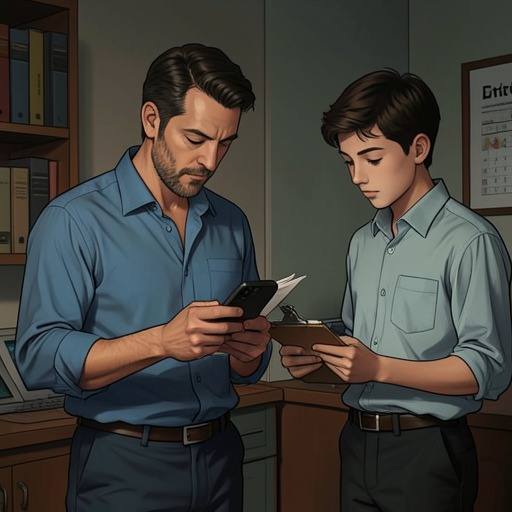
Eli is behind the counter, stuffing something into a duffel bag, with his back to the door. Seeing him brings back Auden’s familiar response from the preceding weeks: embarrassment about her own conduct, immediately followed by the urge to flee. She grips the sign in her hand more tightly and stays. The gesture supplies a physical counterpoint to the impulse to run; her determination is visible not as composure but as holding on and continuing.
The Invitation
Auden’s first words come out loud, ragged, and rushed. She tries to breathe before Eli turns around, and meets his wary expression and brief question about what is happening. She had imagined easing into the subject with carefully chosen phrasing, but instead asks whether he remembers the first time they went bowling. The question gives her a way into the conversation through a shared memory rather than beginning with a polished explanation.
Eli remembers. Auden feels her nerve ebbing, yet continues and explains that what they had together was her first experience of a relationship that mattered. She says she was not good at being with him, that the unfamiliarity frightened her, and that she did not want to try because she did not know what she was doing. She also tells him that he had been right about the bike. Her apology therefore addresses more than a single awkward moment: she links her difficulty with their relationship to the same reluctance to attempt something she might do badly.
Auden makes the request explicit. She apologizes, invokes the phrase “chicken salad,” and says she wants to follow Eli’s advice to keep trying. She then asks him to go to the prom with her that night. The invitation is both specific and immediate: it proposes a shared evening, but also puts her newly stated intention into practice. The scene’s central action is not simply that she says she is sorry; she asks Eli to meet her in a future encounter after acknowledging why she had withdrawn before.
Eli’s Refusal
Wallace calls from behind Eli, announcing that the train is leaving and it is time to go. Eli does not answer him. He remains focused on Auden, serious, while she looks back and recalls the hours they spent together, which had begun and ended in nearly this same place. The bike shop thus holds a particular history for them; Auden sees it as an apt setting in which to find out whether their relationship will continue or end.
Eli says he is sorry, but cannot go. He picks up the duffel bag and slings it over one shoulder. Auden nods, stunned. After one last look, intense and almost sad, he turns away, passes Adam and Wallace through the office, and disappears from view. The door bangs shut a second later. The sequence gives the refusal a clear physical ending: Eli does not remain to negotiate the invitation, and Auden is left at the counter after the departure she had feared.
Adam approaches and begins to ask whether Auden is looking for Eli, noting that Eli has just gone. Auden quickly says no. Her answer comes after the scene has already shown why she came, so it does not undo the request; instead, it registers the immediate shock of being left behind and the difficulty of acknowledging the moment to someone else.
Consequence and Significance
The invitation changes what Auden is willing to do, but it cannot determine Eli’s response. She has moved from regret and an urge to escape toward a direct apology and a request to try again. Eli’s refusal reverses the hopeful possibility she had carried into the shop: the conversation ends not with a date for the dance but with his departure and a shut door.
The setting and the remembered bowling outing make the scene look back as well as forward. Auden uses an early shared memory to explain how she understands her own inexperience, while the shop recalls the hours that have brought them together. Returning to that place gives her attempt at repair a shape, but not a guaranteed result. The ending holds together two facts the scene does not resolve into one: Auden has finally acted on her wish to keep trying, and Eli has declined the invitation. The second chance she offers is real as an act of courage and accountability, even though it does not secure a second chance between them.